
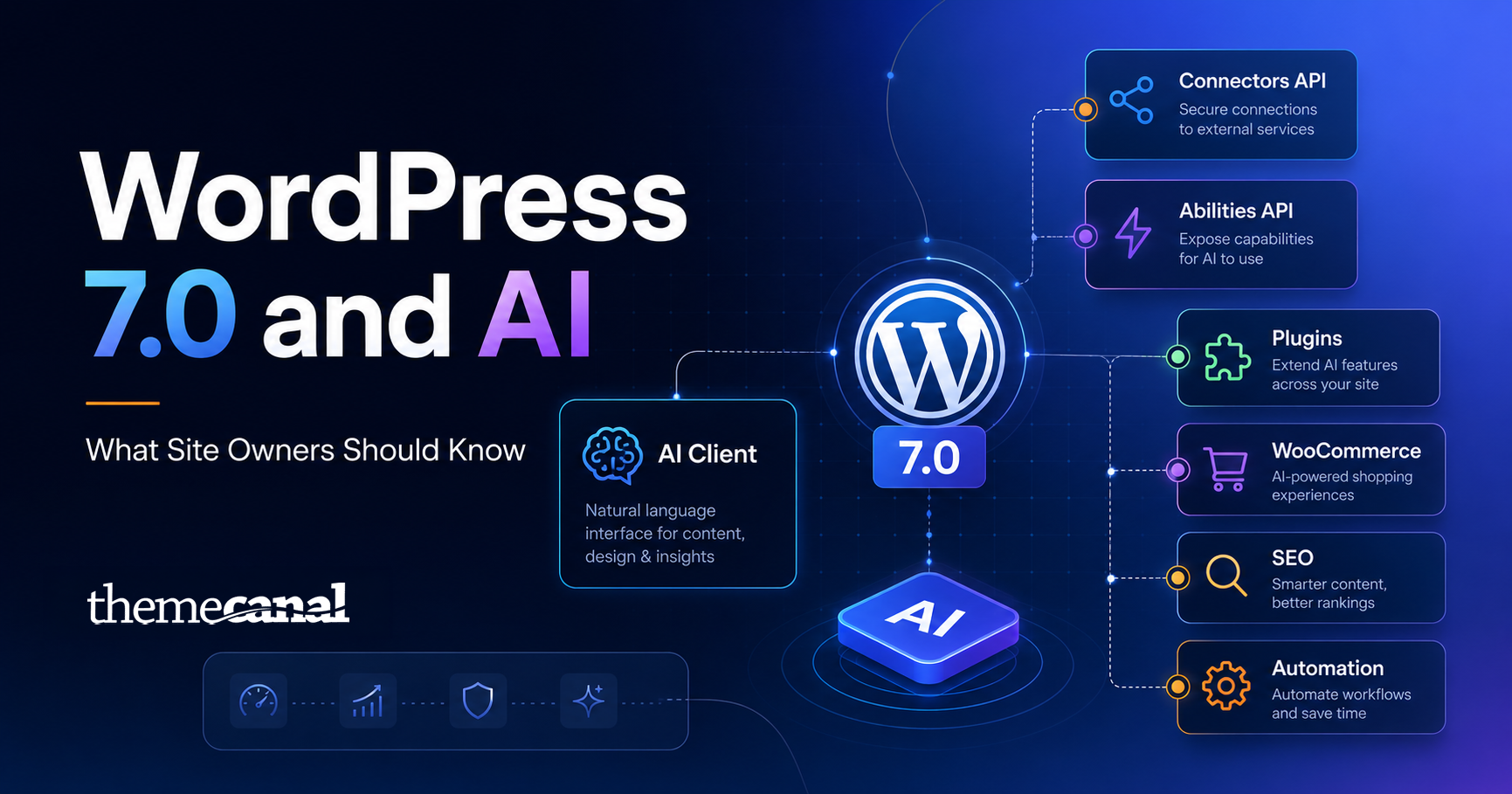
WordPress 7.0 and AI: What Site Owners Should Know


WordPress 7.0 and AI make one thing pretty clear: AI is no longer just something happening around WordPress. It is starting to become part of how WordPress itself can connect, automate, and support smarter site workflows.
That does not mean WordPress is turning into an autopilot website machine overnight. Site owners are not suddenly being replaced by a glowing robot with a clipboard. But WordPress 7.0 does matter because it introduces more serious foundations for AI-powered plugins, provider connections, automation, and future site management tools.
My take is simple: WordPress 7.0 is less about flashy AI tricks and more about infrastructure. The important part is not that AI can write a paragraph. The important part is that WordPress is starting to give plugins, developers, and site owners a cleaner way to work with AI inside the platform.
WordPress 7.0 and AI: What Changed?
The biggest mistake is treating WordPress 7.0 and AI like a small feature update. The more useful way to look at it is this: WordPress is beginning to create a shared foundation for AI-powered tools.
Before this shift, most AI features in WordPress lived in separate plugins or external tools. One plugin might connect to one AI provider. Another plugin might use a different setup. Another might require its own API key, its own settings screen, and its own workflow.
That can work, but it gets messy fast.
WordPress 7.0 starts moving toward a cleaner model where AI-related features can be handled through more consistent platform-level systems. The important names to know are the AI Client, the Connectors API, and the Abilities API.
External references: WordPress 7.0 Field Guide and Introducing the AI Client in WordPress 7.0.
Why WordPress 7.0 Matters for Site Owners
Most site owners do not need to know every technical detail behind WordPress 7.0. You do not need to memorize API names or pretend release notes are bedtime reading. Tiny mercy.
But you should understand the bigger picture.
WordPress 7.0 matters because it points toward a future where AI features are not just random add-ons. Instead, AI can become part of how plugins, settings, content tools, ecommerce features, and workflow automation connect to WordPress.
For site owners, that could eventually mean better tools for:
- Writing and improving content
- Generating product descriptions
- Creating alt text and excerpts
- Understanding plugin settings
- Finding likely conflicts
- Improving SEO structure
- Automating repetitive admin tasks
- Helping support teams answer common questions
- Connecting WordPress to AI providers in a cleaner way
The key word is eventually. WordPress 7.0 is not magic dust. It is a foundation. What gets built on top of that foundation will matter most.
Plugins can start building AI features around a shared system instead of every tool inventing its own setup.
AI providers can be handled in a more organized way through connectors and shared configuration.
Abilities and automation tools can make WordPress easier for AI assistants and workflow systems to understand.
The AI Client: Why It Matters
The AI Client is one of the biggest pieces of this story.
In plain English, the AI Client gives WordPress plugins a more consistent way to send prompts to AI models and receive results. Instead of every plugin building its own separate AI plumbing, the platform can provide a shared way for plugins to communicate with AI providers.
That matters because fragmented AI integrations can get messy. If every plugin has its own AI provider settings, API key fields, connection logic, and output handling, site owners end up managing a drawer full of mismatched cables.
A shared AI Client can help make AI-powered WordPress features more consistent over time.
For site owners, this could eventually lead to plugins that are better at:
- Generating content from inside WordPress
- Creating SEO suggestions
- Summarizing site data
- Helping with product copy
- Creating support responses
- Reviewing page structure
- Suggesting fixes without each plugin reinventing the wheel
The AI Client does not mean every WordPress site should immediately start using AI everywhere. It means WordPress is creating a cleaner technical path for AI features to exist inside the ecosystem.
The Connectors API: Cleaner AI Provider Connections
The Connectors API is another important piece.
If the AI Client is the way plugins can talk to AI models, the Connectors API helps manage the connection side of the equation. It gives WordPress a more standardized way to register and handle external service connections, with AI providers being the first major focus.
This matters because one of the annoying parts of AI tools is setup. API keys, provider settings, account connections, permissions, and configuration screens can become a mess if every plugin handles them differently.
With a cleaner connector system, WordPress can move toward a future where site owners connect an AI provider once, then compatible plugins can use that connection in a more organized way.
External reference: Introducing the Connectors API in WordPress 7.0.
That is the kind of change that may not look exciting in a screenshot, but it can make a big difference behind the scenes.
The Abilities API: Helping Tools Understand What WordPress Can Do
The Abilities API is another part of the bigger AI and automation picture.
The idea is that WordPress core, plugins, and themes can expose what they are capable of doing in a more structured way. That matters because AI agents, workflow tools, and automation systems need to understand what actions are available before they can safely help with anything.
Think of it like giving WordPress a clearer menu of actions. Instead of an AI tool guessing what a plugin can do, the plugin can describe its abilities in a standardized format.
For site owners, this could eventually help with tasks like:
- Finding available plugin actions
- Automating site maintenance tasks
- Triggering workflows from natural language prompts
- Connecting tools without custom glue code every time
- Helping AI assistants understand WordPress features more safely
External reference: Introducing the WordPress Abilities API.
How AI Could Change Plugin Workflows
I do not think AI will make plugins less important. If anything, it may make good plugins more valuable.
WordPress still runs on its plugin ecosystem. SEO plugins, WooCommerce extensions, form plugins, caching tools, security plugins, builders, search plugins, analytics tools, and design extensions are not suddenly going away.
What may change is how site owners interact with those tools.
Instead of opening a plugin settings screen and wondering which checkbox might summon a layout demon, AI-assisted workflows could eventually help explain what settings mean, what conflicts might happen, and what setup path makes sense for your site.
That could be useful for:
- Understanding SEO plugin settings
- Choosing safer caching options
- Reviewing WooCommerce extension conflicts
- Summarizing plugin changelogs before updates
- Identifying overlapping plugin features
- Guiding new users through setup screens
- Helping developers expose plugin features to AI workflows
This is also why choosing good plugins still matters. AI cannot turn a messy, abandoned, poorly coded plugin stack into a clean foundation. It can only help if the tools underneath are reliable.
If you are reviewing your setup, our Plugin Guides category is where we are building practical plugin-focused resources. You can also browse WordPress plugins if you already know what type of tool your site needs.
Content Creation Will Get Faster, But Not Automatically Better
AI can already help with content. That part is not new.
It can help draft outlines, write rough product descriptions, generate FAQs, suggest meta descriptions, clean up category copy, summarize research, and turn messy notes into something readable.
But faster content is not automatically better content.
The risk is that AI makes it easy to publish generic articles that sound polished but say very little. That kind of content may fill a blog archive, but it does not build trust. It does not show experience. It does not help someone make a smarter decision.
The better use of AI is not “write everything for me.” It is more like:
- Help me organize what I already know
- Turn rough notes into a clearer draft
- Suggest questions my customers might ask
- Find missing details on a product page
- Improve readability without stripping personality
- Help create a better article structure
Google’s guidance still points toward helpful, reliable, people-first content. AI can help with the process, but the final article still needs judgment, usefulness, accuracy, examples, and a real point of view.
External reference: Google’s guide to helpful, reliable, people-first content.
WooCommerce Stores May Benefit From AI Workflows
WooCommerce is one of the areas where AI could become especially useful because stores have so many moving parts.
A WooCommerce site is not just a website. It is products, categories, payments, shipping, checkout, customer accounts, order emails, coupons, support requests, analytics, and inventory.
AI could help store owners with:
- Writing clearer product descriptions
- Improving product category copy
- Suggesting cross-sells and upsells
- Summarizing customer questions
- Improving abandoned cart emails
- Finding weak checkout messaging
- Creating better product FAQs
- Identifying products that need stronger SEO content
The important part is control. AI should support the store owner, not invent product claims, fake benefits, incorrect specs, or unsupported promises. Product content needs to be accurate, useful, and trustworthy.
For store-specific resources, visit our WooCommerce Guides category. If you are looking for tools to extend your store, browse our WooCommerce Extensions.
SEO, Search, and AI-Generated Answers
AI is not only changing WordPress. It is also changing how people find information.
Traditional search still matters, but more users are getting answers from AI summaries, assistants, chat-based search tools, and recommendation engines. That does not mean SEO is dead. It means weak SEO is getting less forgiving.
Thin content, vague product pages, missing details, and generic blog posts are not a strong long-term plan.
For WordPress site owners, this makes a few things more important:
- Clear page structure
- Useful product and category descriptions
- Strong internal links
- Updated content
- Visible FAQs when they help the reader
- Schema markup used properly
- Comparison content that helps users decide
- Original commentary based on real experience
AI search systems need clear information to work with. Human readers need the same thing. That is why useful structure, clear answers, and honest detail matter more than ever.
For more optimization-focused articles, visit our SEO & Performance category.
What Site Owners Should Be Careful About
WordPress 7.0 and AI are exciting, but this is not a “turn everything on and hope” situation.
AI features can create real value, but they also create new things to think about.
- Privacy: Be careful what site data gets sent to external AI providers.
- Accuracy: AI can produce confident mistakes, especially with product details, pricing, legal claims, or technical instructions.
- Plugin quality: AI-powered features are only as good as the plugins implementing them.
- Cost: AI provider usage may come with API costs, especially for busy sites or advanced features.
- Permissions: AI tools need clear boundaries. Not every assistant should be able to change important site settings.
- Content quality: Publishing more does not mean publishing better.
The best approach is careful adoption. Test AI features. Review outputs. Keep humans in control. Do not let automation become a tiny forklift driving through your content library.
What WordPress Site Owners Should Do Now
You do not need to rebuild your site because WordPress 7.0 adds more AI-focused infrastructure.
But you should start preparing your site for a more automated, more connected, and more workflow-driven WordPress future.
Here is what I would focus on first:
- Clean up your plugin stack. Remove tools you do not use and avoid plugins with overlapping jobs.
- Keep plugins, themes, and WordPress core updated. AI-ready workflows will not help much if the site foundation is stale.
- Improve your important product and category pages. Add useful details, not just filler text.
- Use structured data properly. Article, Product, FAQ, and Breadcrumb schema can all help when used correctly.
- Use staging before major updates. WordPress 7.0 is a major release, so test first if your site matters.
- Review AI plugin permissions carefully. AI features should not have more control than they need.
- Use AI as an assistant, not autopilot. Let it help with drafts, ideas, structure, and editing, but keep human judgment in charge.
The websites that benefit most from AI will probably not be the ones that publish the most content. They will be the ones with the clearest structure, the strongest information, and the best workflows.
Where Theme Canal Fits In
Theme Canal is focused on practical WordPress tools: plugins, themes, WooCommerce extensions, and resources that help people build better websites without overcomplicating the process.
As WordPress becomes more AI-ready, the quality of your tools matters even more. A messy site with conflicting plugins, weak theme foundations, outdated extensions, and thin content will not become great just because AI is nearby.
A better approach is to build a cleaner foundation first.
WordPress 7.0 and AI are not a reason to install everything. They are a reason to be more intentional about what your site runs, what your content says, and how your tools work together.
Final Thoughts
WordPress 7.0 and AI are not about replacing site owners, developers, or content creators overnight.
The bigger story is infrastructure. WordPress is starting to make AI features more consistent, more connected, and easier for plugins to build around.
That matters because the future of WordPress will probably be less about one giant AI button and more about smarter workflows: better plugin setup, cleaner provider connections, stronger content tools, improved WooCommerce operations, and more useful automation.
AI may help steer the ship, but site owners still need to know where the canal is going.
Common Questions About WordPress 7.0 and AI
WordPress 7.0 introduces important AI-related foundations, but site owners do not need to panic or chase every shiny new tool. Here are a few practical answers.
What changed with WordPress 7.0 and AI?
WordPress 7.0 introduces stronger AI-related foundations, including the AI Client, Connectors API, and Abilities API. These changes help WordPress, plugins, themes, and future automation tools work with AI providers and site capabilities in a more structured way.
Does WordPress 7.0 mean AI is built into every site?
Not exactly. WordPress 7.0 provides infrastructure that plugins and tools can use to build AI-powered features. Site owners still need to choose which AI features to enable, which providers to connect, and how much control those tools should have.
What is the WordPress AI Client?
The WordPress AI Client gives plugins a more consistent way to send prompts to AI models and receive results. Instead of every plugin building its own separate AI integration, the AI Client creates a shared path for AI-powered WordPress features.
What is the Connectors API in WordPress 7.0?
The Connectors API helps WordPress manage external service connections in a more standardized way. For AI, it can help providers and API key connections become cleaner and easier for compatible plugins to use.
Will WordPress 7.0 AI features help WooCommerce stores?
Potentially, yes. AI-powered WooCommerce workflows could help with product descriptions, category copy, customer support drafts, email improvements, product FAQs, and better content organization. Store owners should still review every AI output for accuracy.
Should site owners use AI on WordPress right away?
Site owners should be thoughtful. AI can be useful, but it should be tested carefully, reviewed by humans, and limited to tasks where it genuinely helps. The best approach is to treat AI as an assistant, not autopilot.